
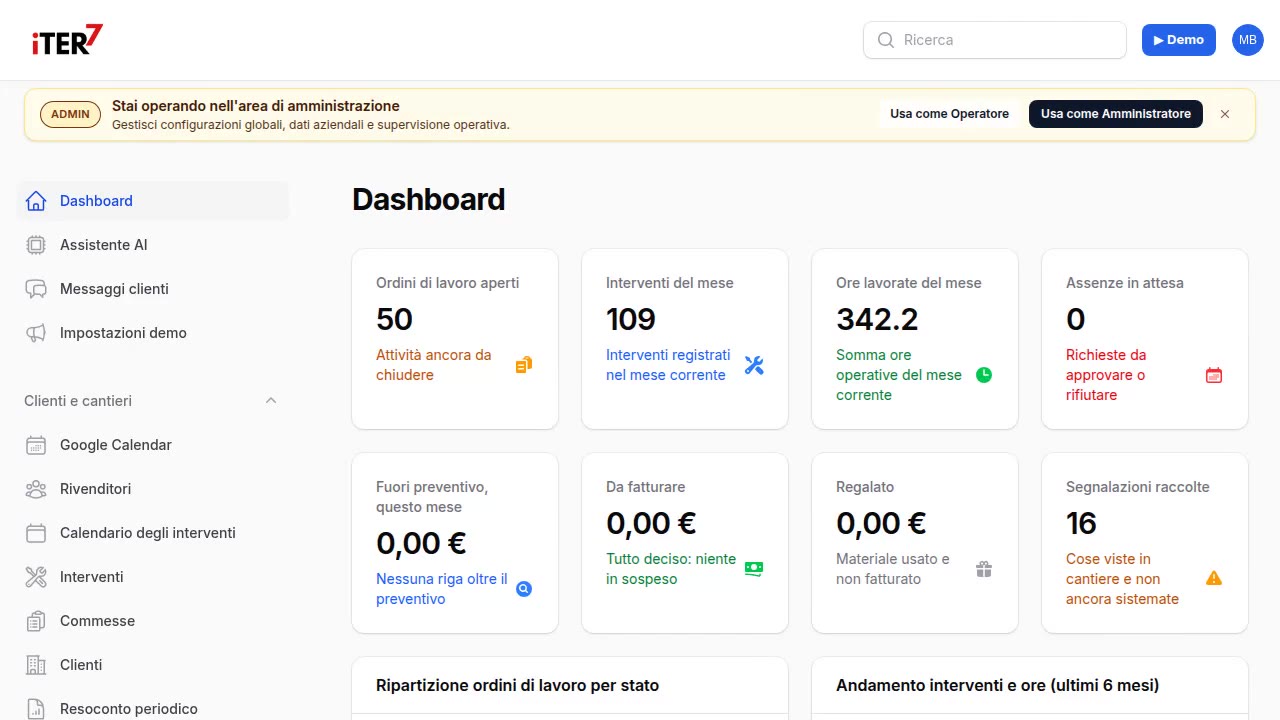
iTER7 is the management system for heating and boiler-maintenance contractors where deadlines generate the jobs and the technician dictates the report by voice at the end of the visit. Three questions before you go on: how many boilers under contract skip their maintenance every season? Who retypes the reports in the evening? How many visits end without the customer's signature?
Do you recognise at least two of these?
- In September the office spends days calling customers for annual maintenance, with a spreadsheet nobody has updated since March.
- The installation logbook and the inspection report are filled in by hand, twice: on paper and then in the regional portal.
- The F-Gas register for air-conditioning units is in a folder, and when an inspection is requested it is reconstructed by hand.
- Valves, fittings and spare parts go on the van and half of them appear on the invoice.
- The customer disputes a job from three months ago and you find neither signature nor photos.
If you said yes at least twice, the problem is not the people: it is that the process lives on tools that do not talk to each other.
What does a maintenance season run from memory really cost?
- Every annual maintenance not called back is a customer who calls someone else: on 300 boilers under contract, 10% forgotten is 30 lost jobs.
- A properly written report costs, estimated from demos, 12-15 minutes: with four jobs a day about four hours a week per technician. Dictated by voice it drops to three.
- One job a week not invoiced because the report never came back: at an average ticket of 80 € that is over 4,000 € a year (example).
- Material that goes on the van and appears on no invoice: on five vans, 30 € a week each is enough to pass 7,000 € a year.
What if deadlines generated the jobs by themselves?
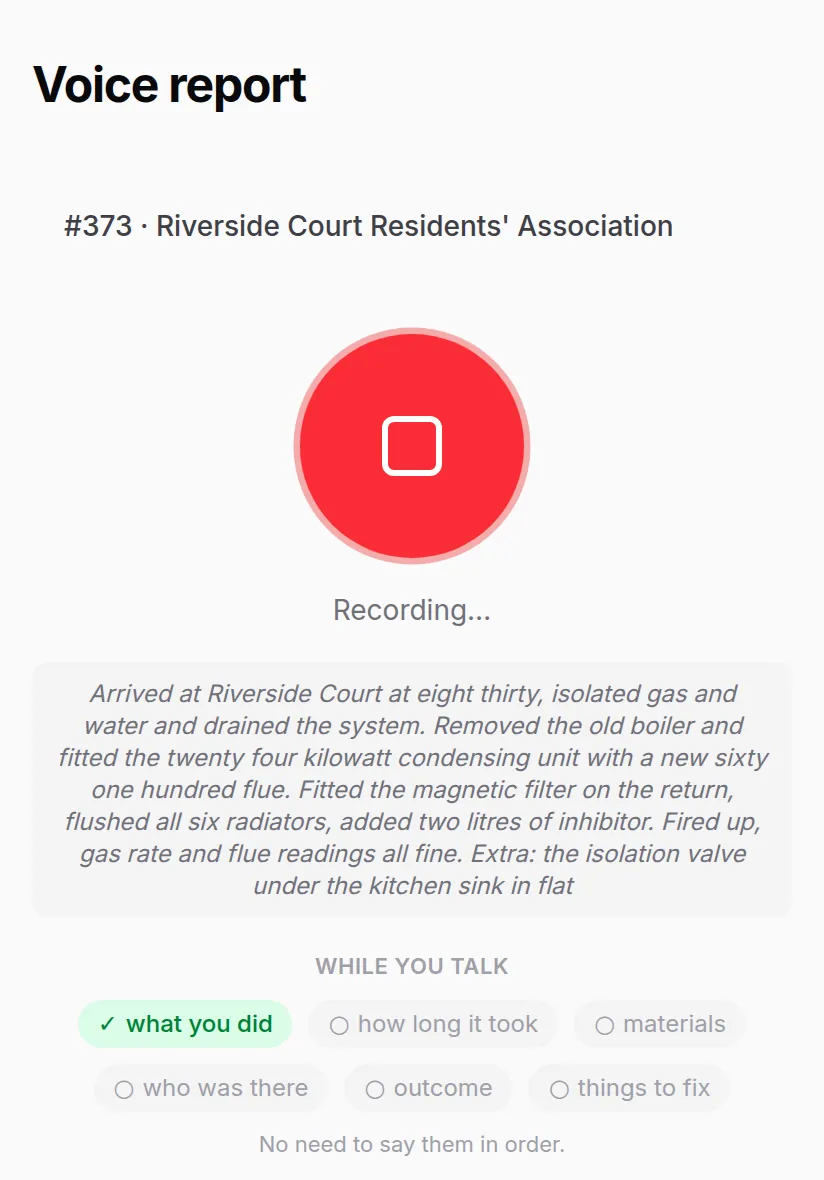
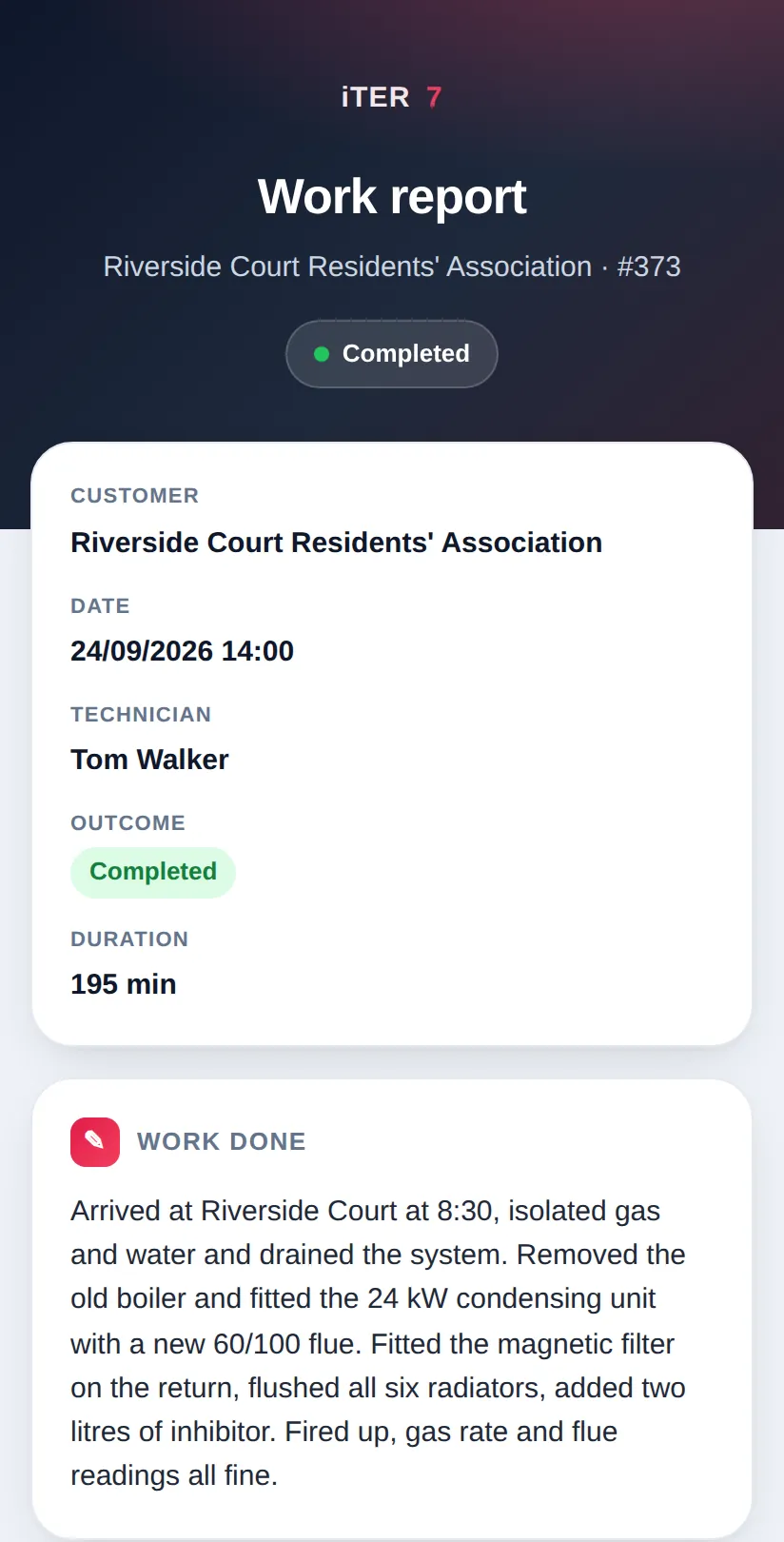
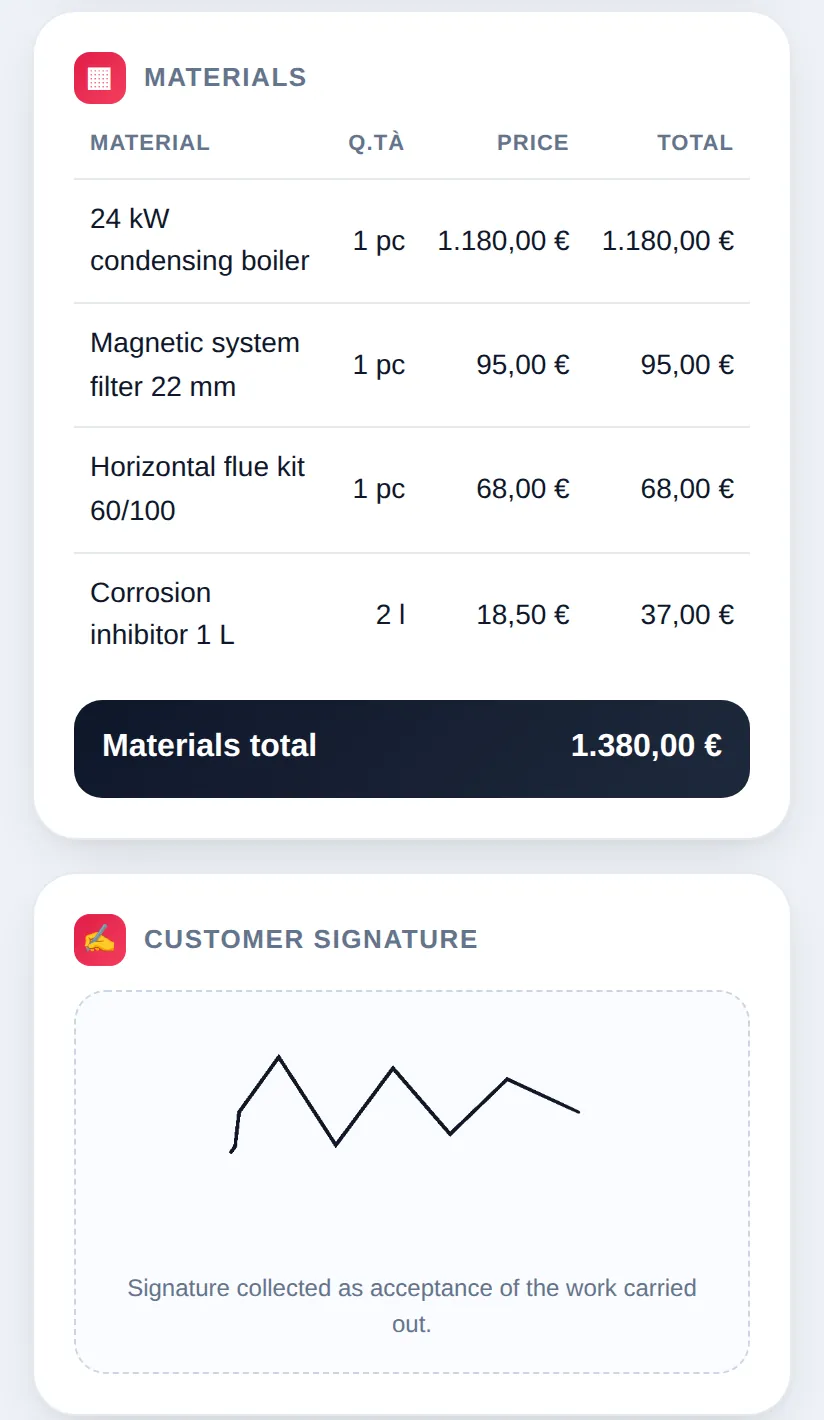
Picture September like this. Every installation has its own record: boiler, brand, output, date of the last check, contract. At the end of August iTER7 prepares the list of maintenance due, sends the customer a reminder by WhatsApp or email and puts the job in the calendar when the customer confirms. The technician arrives, dictates the report by voice, ticks the spare parts from the van, attaches the photo of the combustion analysis; the customer signs on the phone and the PDF goes out immediately, with a public link.
- Maintenance under contract is no longer forgotten: it is scheduled jobs, not phone calls.
- The installation logbook and the F-Gas register stay linked to the installation, with the history of every job.
- Every van is a stock location with its own quantities: the gap between loaded and used becomes a number.
- The electronic invoice comes out of the signed report, without retyping.

Real iTER7 screens on the technician's phone. The data is demo data, not a customer's.
What is there for boilers, air conditioning and F-Gas, and what is not?
There is: the installation record with deadlines and contract, scheduled maintenance, the F-Gas register per unit with the operations of every job, the report with photos and signature, electronic invoicing. The energy-efficiency inspection report is filled in from the job report with the installation data and attached; automatic submission to regional registers depends on the region and is assessed in the demo, with no promises.
iTER7 runs in the phone browser, Android or iPhone, with nothing to install: open a link and work. Photos, finger signature and voice notes work from there. With a weak signal the light pages still open; fully offline use is not there today and is among the possible customisations. Electronic invoicing follows the Italian SDI system: iTER7 is built for installation companies working in Italy.
Where it comes from and why you can trust it
iTER7 was not designed at a desk: it comes from the modules already in production in the installation companies followed from Noale, near Venice, and from fourteen years of business software. It is a ready-made product: setup takes usually two to four weeks, depending on customisations (configuration, data import, on-site training) and the on-site visit looks at how you work, not at how an "average" company works.
- Price per company: add a technician and you pay no more.
- Your data stays yours: exportable at any time, and if you wish the software installed on your own hosting.
- No multi-year lock-in: if you no longer need it, you stop.
How much does it cost (after you know what not having it costs)
Launch price list, no VAT charged (Italian flat-rate scheme), per company, not per user: add a technician and you pay no more.
- Basic, 99 € a month: job calendar, work reports from the phone with photos and customer signature, customers and installations, PDF with your logo.
- Pro, 199 € a month: everything in Basic plus voice-dictated work reports, per-van stock with QR codes, quotes and electronic invoicing (sent to Italy's SDI through your provider), WhatsApp and email notifications.
- Setup, from 500 to 1,500 € one-off: configuration, data import from spreadsheets or the old system, on-site training for technicians.
199 € a month is 2,388 € a year, against thirty forgotten maintenance visits. Details on how much iTER7 costs.
The sensible next step
No need to decide today. The right step is small: describe how you work and send me one week of real jobs; I reply in writing with how they would run in iTER7. If it is not for you, you still keep a written list of where you are losing time, free.
Demos are on site across Veneto and remote across Italy; starts are scheduled one at a time. Contact us, or first read how much iTER7 costs.
iTER7 at an installation company
Veneto · jobs, work reports, per-van stock
Why it matters: an installation company gets paid only once someone rebuilds what was done. Here the technician describes the job by voice, the customer signs on the phone and the invoice starts from the signed report: no paper to copy out in the evening, no forgotten extra work.
Before: paper work reports retyped in the evening, signatures to chase, materials disappearing from the vans, late invoices because first someone had to rebuild what had been done.
What was built: iTER7 with a job calendar, work reports dictated by voice on the phone, the customer's signature on screen, per-van stock with QR codes, branded PDFs and the electronic invoice from the signed report.
What changed: the work report is ready when the job ends, signed, and the invoice starts from there. No sheets to retype. Before-and-after times are being measured with the client: the numbers will appear here once measured, not estimated.
The AI inside: an assistant you talk or write to in Italian ("my jobs this week", "how many of this item are in van 2", "close the job"): it searches customers, jobs, stock and bills of materials on its own and prepares the action. The dictated work report becomes a draft with materials taken from the catalogue, and the system flags materials used beyond the quote. Quotes can be dictated too. Customers' WhatsApp messages and emails arrive already sorted: what they ask for, which job they refer to, what to do next. Photographed or PDF documents read themselves.
AI security: the AI proposes, a person confirms, and who and when is recorded. The assistant can only perform actions from a closed list, with a cap on proposals every ten minutes; manipulation attempts (prompt injection) are filtered; emails, IBANs, tax codes and card numbers never reach the logs. Coverage of the OWASP risks for LLM applications is documented item by item, including the ones not covered.
Data and AI: a dedicated instance for the company, data exportable at any time. AI models are chosen and changed in configuration (the interface also works with models hosted in the company); bill reading uses a service in the EU region. Under the AI Act it most likely falls under limited risk: the assistant states that it is automated and that nothing runs without confirmation, and it never evaluates people.
Try it yourself: the free demo opens with your own data: you just sign up with your email.