
Where it started
On a battery pack line every pack moves from one station to the next: cells come out of their boxes, get measured and sorted, are welded, the pack is assembled and finally tested. Every station runs its own check.
Before, functional tests, end-of-line testing and station photos lived in separate systems. To find out what had happened to a pack you had to put together pieces taken from different places.
Why was keeping the data separate not enough?
Because a defect had no history. A reject was explained out loud, and what the most experienced tester knew stayed in that person's head: when the shift changed, you started again.
Then there is the law. From 18 February 2027, Regulation (EU) 2023/1542 requires a digital passport for industrial batteries and for electric-vehicle batteries above 2 kWh. With data spread over three systems, a pack's history cannot be rebuilt in time.
What the MES does
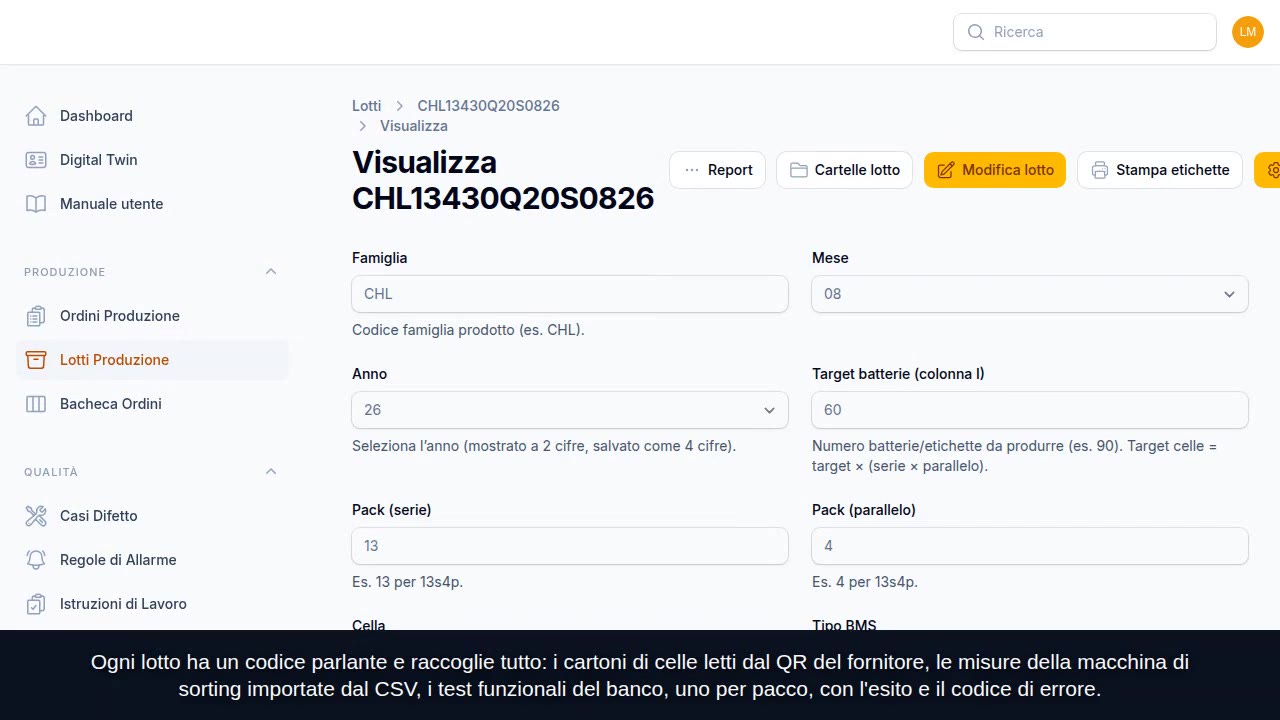
It follows every pack by serial number, from the cells to the final test: cell boxes, sorting measurements, tests, station photos and defects. Every station has its own print queue and prints labels on its own printer.
Defects are no longer a side note: they are recorded as events, with the phase and the station where they started, and there are alarm rules. Statistics can be read by station and by phase. For every pack the MES prepares a PDF passport with its production history.
The company kept the management system it already had: the MES reads from it and writes to it, it does not replace it. It runs on the company's server, networked with the stations, so photos and measurements never leave the plant.
What changed
Out of about 7,500 packs a year, each one has its passport and every reject has a cause tied to a station. From the serial number you find the pack's history without asking anyone.
I have not measured a before and after in hours or euros, and I do not write numbers I do not have.
What runs in production?
Everything on this page works every day on the line, in the province of Treviso.
- The MES described above.
- AI weld inspection, built from the study on 23,194 real photos from the line: what we found in the photos.
- Defect correction guidance: work instructions that adapt to the operator and walk them through the fix. It is the idea I submitted to the European AID4SME call, scored 12.3 out of 15 by the experts: BattWISE.
Do you run a production line too?
If you assemble battery packs, or another product where every piece needs its own history, I build the MES around the way you work, with what I learned here. I do not work alone: collaborators join when needed, but the person who designs and writes the code is the person you talk to.
We start by seeing the line, then a clickable mockup from €600 to €1,500 (10 per cent of the build, fully deducted from the total) and a written quote in stages. Your management system is not touched. No VAT charged (Italian flat-rate scheme).
Describe your problem: free analysis, feasibility check and quote.
MES for a battery pack line
Province of Treviso · 7,500 packs a year · in production
The video: the MES demo with sample data: dashboard, orders, a lot with cell sorting measurements, the pack passport, defect cases and alarm rules.
Status: in production in the province of Treviso, including AI weld inspection and defect correction guidance.